Human Physiology
Cathy Bill, Julie Posey, Merideth Sellars, Sharon Barnewall & Randy Mogg
Turn its ideas into short, game-like lessons you’ll actually finish.
About Human Physiology
Human physiology tells us how the body works, how we think, how we feel, why we get hungry and why sleep is so important. But why the e-book for physiology? Because this interactive experience can help to make physiology come alive. Watching custom videos that truly let the reader see and understand what is happening at the cellular level with each thought and action helps us to relate. The videos you will find here, the images that are one of a kind, the stories, and the lectures all engage the user to not only experience learning in a whole new way, but in a highly interactive, intelligent and fun way. This unique digital tool will prepare you for your undergraduate or even graduate level courses in a way no other text could.
This is so much more than a traditional textbook. The authors of this multi-touch book believe there is more to learning than reading a static text, making notecards, and memorizing for hours on end. We strongly believe that “living” the material, “experiencing” the facts, “watching the text unfold” is a much more active, enjoyable and fruitful way to learn. Each e-book in the 6-book series contains one-of-a-kind animations, where we explain the detail, with wonderful dialogue so you can see and hear physiology come to life. Push buttons, hear our stories, watch amazing videos, and realize all the while you are learning physiology. With this new approach, you engage in the ideas presented, and prepare yourself for the best way to understand just how fascinating the human body is.
Within this digital text, you will find:
- Over 600 pages of text and multi-touch features
- Over 450 high-quality images
- 87 unique animations with self-assessments, video remediation and study guides
- 25 brief audio/video presentations
- Nearly 1,000 self-assessment questions
- An interactive glossary
- Highlighting capability
- ADA compliance
• Book A contains information on Homeostasis, Chemistry, Cellular Transport (including osmolarity and tonicity) and Neurophysiology
• Book B contains information on Sensory Receptors, Pain and Sleep
• Book C contains information on Memory, Cerebral Hemispheres, Language, Skeletal Muscle Physiology, Endocrine Physiology and Cardiovascular Physiology
• Book D contains information on Blood, Respiratory Physiology, Acid Base Balance and Thermoregulation
• Book E contains information on Renal Physiology, Fluid and Electrolyte Balance and Digestive Physiology
• Book F contains information on Reproductive Physiology
A smarter reading
and learning experience.
Hooked from page one.Every lesson opens on a question you want to answer, so your mind stays on it instead of drifting off.
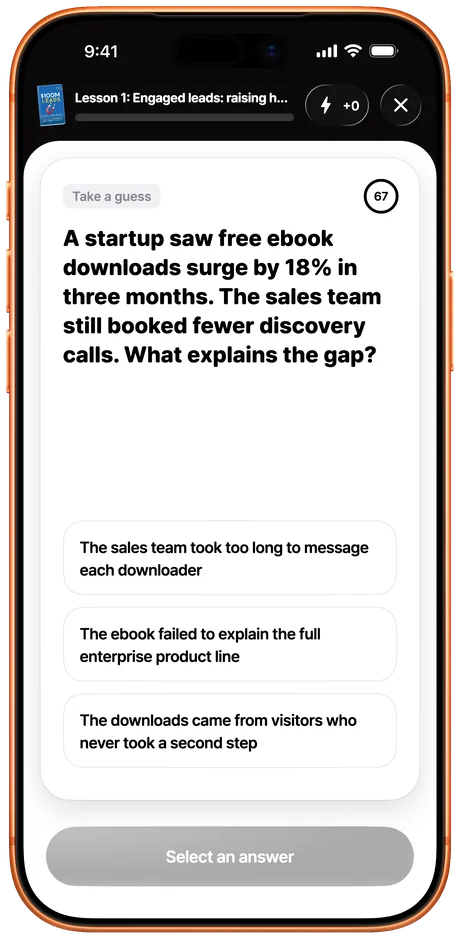
Get it in seconds.Right after you answer, a few plain words show why. No dense chapters to push through.
Use it this week.Pick the moment you’ll use the idea in your own life, so it turns into a habit, not a highlight.
Questions about Human Physiology
What is Human Physiology about?
Human physiology tells us how the body works, how we think, how we feel, why we get hungry and why sleep is so important. But why the e-book for physiology?
Who wrote Human Physiology?
Cathy Bill, Julie Posey, Merideth Sellars, Sharon Barnewall & Randy Mogg wrote Human Physiology.
Is there a summary of Human Physiology?
MEMRBL doesn’t summarize it. It turns its ideas into short lessons on your iPhone: you guess first, see why, and plan where you’ll use each idea this week.
How do I remember what I read in Human Physiology?
Answer questions about it instead of reading it again. Recalling an idea makes it stick better than rereading it (Pan and Sana, 2021). That is how every MEMRBL lesson works.
What books are like Human Physiology?
The Body, The Brain and I Contain Multitudes. See all books like Human Physiology.
Books like Human Physiology
See all


Explore more books
Put Human Physiology to work.
Short lessons on your iPhone. Free to download.