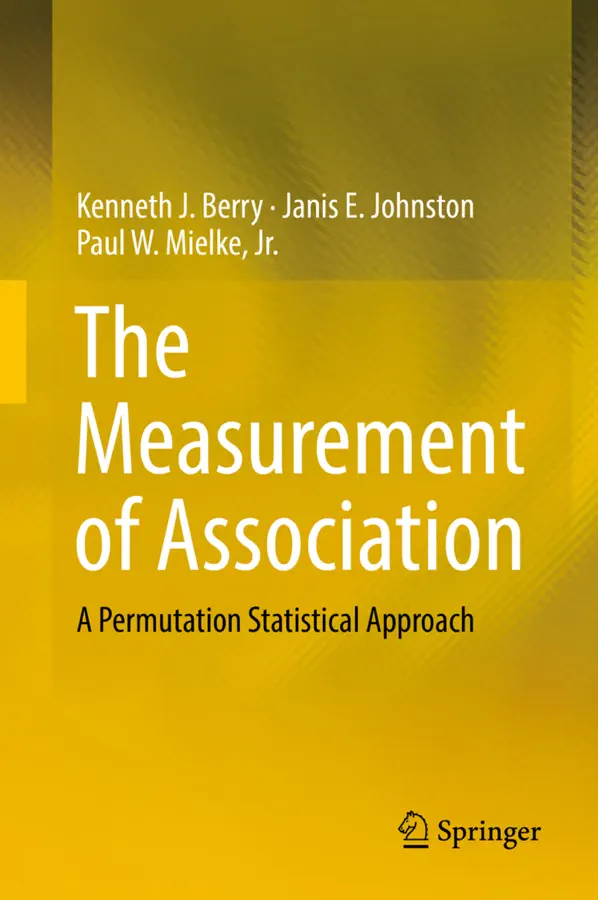
The Measurement of Association
Kenneth J. Berry, Janis E. Johnston & Paul W. Mielke Jr.
Turn its ideas into short, game-like lessons you’ll actually finish.
About The Measurement of Association
This research monograph utilizes exact and Monte Carlo permutation statistical methods to generate probability values and measures of effect size for a variety of measures of association. Association is broadly defined to include measures of correlation for two interval-level variables, measures of association for two nominal-level variables or two ordinal-level variables, and measures of agreement for two nominal-level or two ordinal-level variables. Additionally, measures of association for mixtures of the three levels of measurement are considered: nominal-ordinal, nominal-interval, and ordinal-interval measures. Numerous comparisons of permutation and classical statistical methods are presented.
Unlike classical statistical methods, permutation statistical methods do not rely on theoretical distributions, avoid the usual assumptions of normality and homogeneity of variance, and depend only on the data at hand. This book takes a unique approach to explaining statistics by integrating a large variety of statistical methods, and establishing the rigor of a topic that to many may seem to be a nascent field. This topic is relatively new in that it took modern computing power to make permutation methods available to those working in mainstream research. Written for a statistically informed audience, it is particularly useful for teachers of statistics, practicing statisticians, applied statisticians, and quantitative graduate students in fields such as psychology, medical research, epidemiology, public health, and biology. It can also serve as a textbook in graduate courses in subjects like statistics, psychology, and biology.
A smarter reading
and learning experience.
Hooked from page one.Every lesson opens on a question you want to answer, so your mind stays on it instead of drifting off.
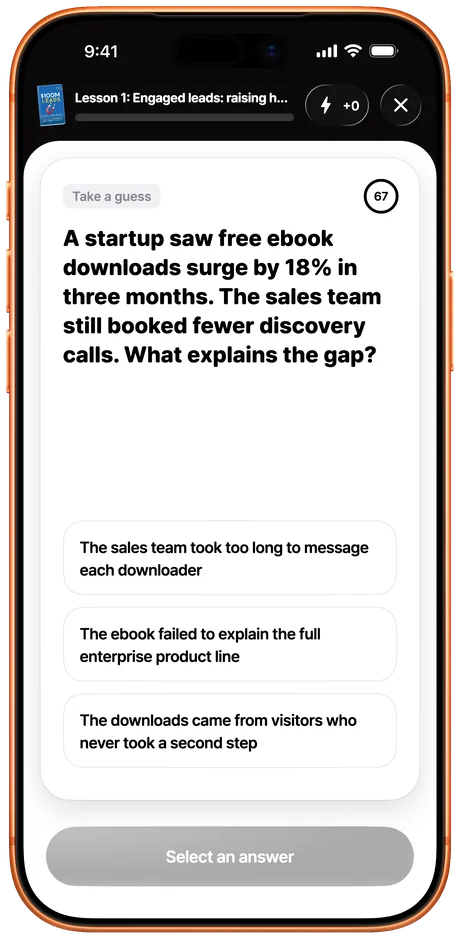
Get it in seconds.Right after you answer, a few plain words show why. No dense chapters to push through.

Use it this week.Pick the moment you’ll use the idea in your own life, so it turns into a habit, not a highlight.
Questions about The Measurement of Association
What is The Measurement of Association about?
This research monograph utilizes exact and Monte Carlo permutation statistical methods to generate probability values and measures of effect size for a variety of measures of association.
Who wrote The Measurement of Association?
Kenneth J. Berry, Janis E. Johnston & Paul W. Mielke Jr. wrote The Measurement of Association.
Is there a summary of The Measurement of Association?
MEMRBL doesn’t summarize it. It turns its ideas into short lessons on your iPhone: you guess first, see why, and plan where you’ll use each idea this week.
How do I remember what I read in The Measurement of Association?
Answer questions about it instead of reading it again. Recalling an idea makes it stick better than rereading it (Pan and Sana, 2021). That is how every MEMRBL lesson works.
What books are like The Measurement of Association?
Naked Statistics, Scale and iPhone User Guide for iOS 8.4. See all books like The Measurement of Association.
Books like The Measurement of Association
See all


Explore more books
Put The Measurement of Association to work.
Short lessons on your iPhone. Free to download.