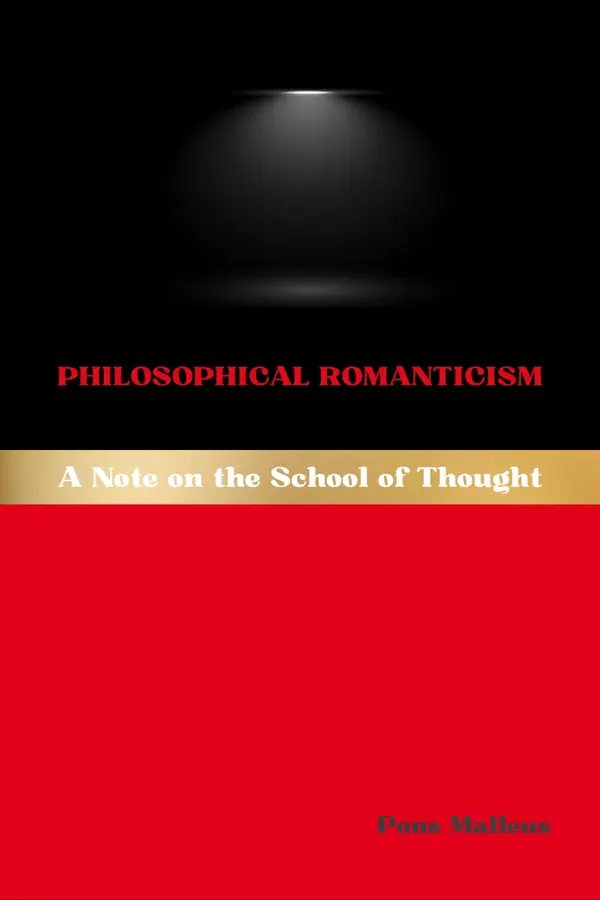
Philosophical Romanticism
Pons Malleus
Turn its ideas into short, game-like lessons you’ll actually finish.
About Philosophical Romanticism
This book arises from a desire to revisit and reexamine one of the most passionate, complex, and oft-misunderstood traditions in the history of philosophy: Philosophical Romanticism. Born in the aftermath of the Enlightenment, Romanticism emerged not merely as a reaction to rationalism, empiricism, and mechanistic science, but as a deep and enduring reorientation of thought—one that insisted on the irreducibility of human experience, the primacy of imagination, and the centrality of the individual in the making of meaning. This was not a retreat into sentiment or unreason, as caricatures sometimes suggest, but rather a philosophical project grounded in a profound interrogation of reason’s limits and a radical affirmation of life in all its contradictions. Philosophical Romanticism is not a school in the formal sense. It has no definitive canon, no singular methodology, and no authoritative voice. It is better understood as a constellation of thinkers—such as Friedrich Schlegel, Novalis, Schelling, and Coleridge—who were united less by dogma than by sensibility. Their writings span literature, science, politics, theology, and metaphysics, and their insights cannot be neatly contained within disciplinary boundaries. This is part of what makes Romanticism so compelling: it is porous, experimental, and alive with tensions. At its core lies a philosophical ambition to think beyond the binary oppositions that often shape Western thought—reason and feeling, nature and culture, self and world—and to move instead toward a vision of unity-in-difference, of the infinite disclosed through the finite. In our own time, marked by ecological crises, technological alienation, and an increasingly instrumental view of human life, Romanticism speaks with renewed urgency. Its refusal to reduce nature to mere resource, its insistence on the poetic dimension of existence, and its embrace of becoming over static being offer important correctives to dominant paradigms. But Romanticism also invites critique. It harbors political ambivalences, aesthetic elitism, and at times a dangerously inflated view of the self. To approach this tradition today is to engage it both sympathetically and critically, to recover what is vital while remaining attentive to what must be rethought. This book does not aim to provide a comprehensive history of Romanticism, nor does it seek to systematize a philosophy that resists systematization. Instead, it offers a series of interpretive essays, thematic inquiries, and close readings that explore the philosophical impulses at work in Romantic thought. Each chapter invites the reader to linger with Romanticism's central questions: What is the relation between self and world? How does imagination disclose truth? What does it mean to live a free and meaningful life in a world not of our making? My hope is that this book will speak not only to scholars of Romanticism but to all those drawn to philosophy as an art of living—a mode of being in the world that is at once critical and creative, rigorous and open. In retracing the steps of these Romantic thinkers, we do not merely excavate a past era; we enter into a dialogue that is still unfolding. Romanticism, after all, is not a closed chapter in intellectual history. It is a mode of thinking that pulses beneath many of our most urgent contemporary concerns, and it continues to offer a vision of philosophy as a living, dynamic, and transformative force. Let us begin, then, not with conclusions but with questions.
A smarter reading
and learning experience.
Hooked from page one.Every lesson opens on a question you want to answer, so your mind stays on it instead of drifting off.

Get it in seconds.Right after you answer, a few plain words show why. No dense chapters to push through.

Use it this week.Pick the moment you’ll use the idea in your own life, so it turns into a habit, not a highlight.

Questions about Philosophical Romanticism
What is Philosophical Romanticism about?
This book arises from a desire to revisit and reexamine one of the most passionate, complex, and oft-misunderstood traditions in the history of philosophy: Philosophical Romanticism.
Who wrote Philosophical Romanticism?
Pons Malleus wrote Philosophical Romanticism.
Is there a summary of Philosophical Romanticism?
MEMRBL doesn’t summarize it. It turns its ideas into short lessons on your iPhone: you guess first, see why, and plan where you’ll use each idea this week.
How do I remember what I read in Philosophical Romanticism?
Answer questions about it instead of reading it again. Recalling an idea makes it stick better than rereading it (Pan and Sana, 2021). That is how every MEMRBL lesson works.
What books are like Philosophical Romanticism?
The German Gita, On Truth and Untruth and Being and Time. See all books like Philosophical Romanticism.
Books like Philosophical Romanticism
See all


Explore more books
Put Philosophical Romanticism to work.
Short lessons on your iPhone. Free to download.