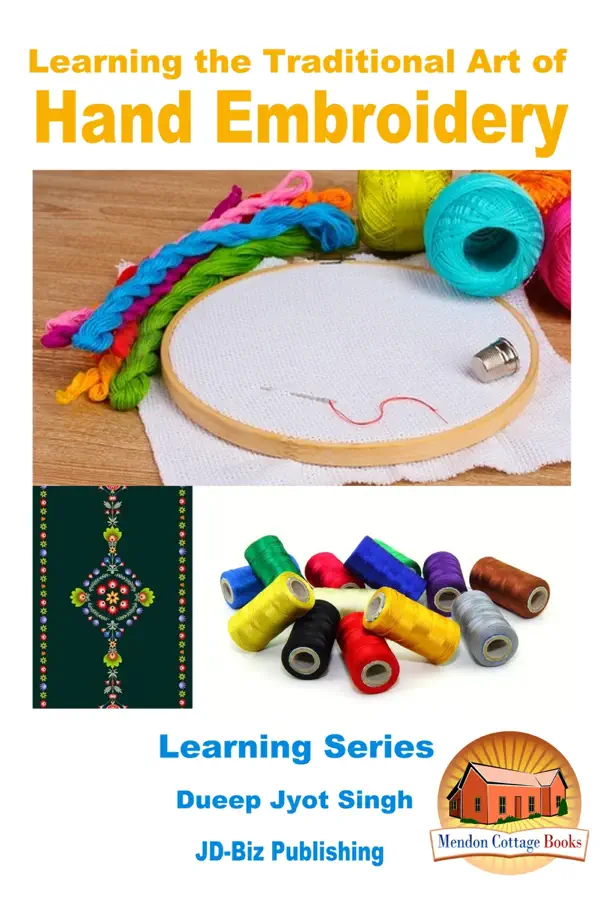
Learning the Traditional Art of Hand Embroidery
Dueep Jyot Singh
Turn its ideas into short, game-like lessons you’ll actually finish.
About Learning the Traditional Art of Hand Embroidery
Table of Contents
Introduction General Principles of the Embroidering Art Selection of Pattern Pattern Position Pattern Laying on the Cloth Things needed Embroidery Needles Selection of the Best Thread Threading During Embroidery Finishing and Starting Yarn Working with an Embroidery Hoop – Transferring the Pattern Copying The Design onto Another Paper/Fabric Different Traditional Stitches of Embroidery Flat Stitch Group Tacking Stitch And Running Stitch Backstitch Stem Stitch Also Known As Outline Stitch Straight Stitch Satin Stitch Long and Short Stitch. Flat Stitch Fishbone and Open Fishbone Stitch Loop Stitch Group Blanket Stitch And Buttonhole Stitch Feather Stitch Double Feather Stitch Fly Stitch, Open Attached Fly Stitch, and Closed Attached Fly Stitch Chain stitch group Open Chain Stitch Twisted Chain Stitch Lazy Daisy, Wheat Ear, and Attached Wheat Ear Stitches Knotted Stitches Group French Knot Stitch Coral Stitch Bullion Stitch Finishing Your Project Blocking Your Design Mounting Appendix Conclusion Author Bio Publisher
Introduction
A thing of beauty is a joy forever and Curly Locks sitting on a silk cushion and sewing a fine seam after dining off strawberries and cream are 2 clichés which have everything to do with keeping oneself adorned with something beautiful, made by one’s own hands.
The instinct of beautifying one’s house and surroundings and also one’s clothes is innate in a human being. And that is why traditional designs incorporated designs, including natural symbols and figures like flowers, animals, leaves, and birds, through needle and thread on a base.
Women used fishhooks and ivory needles 5000 years ago with fiber from plants like cotton thread, jute thread, and even silk thread. Even today, natural fibers are used for embroidery including silk.
We do not know which particular civilization where and how long ago decided to embellish the garments one wore with embroidery. But we do know that ancient civilizations more than 5000 years ago had experts in the art of needle and thread and their families, and these housewives were proud to demonstrate their creative abilities to everyone who came to visit and admire.
When the Spaniards conquered the Philippines, – 1521 to 1799- they wanted to show the natives that they were the conquerors and that is why they ordered them to wear their traditional shirt- Canga untucked in their loin cloths -bahags. The Filipinos in order to show that they were not conquered decorated these shirts with such exquisite embroidery, that each shirt worn became an admirable barong tagalog. When I was young, I had a number of these sent to me by my aunt in the Philippines, – shirts for ladies – which I wore when at college to the great admiration of all my fellow classmates.
You can look at some of the examples in the Appendix and throughout the book. Each of them took anywhere between one and a half years to 3 years to make by hand by my skilled artisan friends through state aided societies for the upliftment of women.. They are now being sold all over the world through nonprofit organizations and the money going straight to the women.
Traditionally, any surface which was present and visible would be embroidered upon and embellished with patterns. So this book is going to tell you all about how you can learn the traditional art of hand embroidery. After that you can try your hand at your own designs.
A smarter reading
and learning experience.
Hooked from page one.Every lesson opens on a question you want to answer, so your mind stays on it instead of drifting off.

Get it in seconds.Right after you answer, a few plain words show why. No dense chapters to push through.

Use it this week.Pick the moment you’ll use the idea in your own life, so it turns into a habit, not a highlight.

Questions about Learning the Traditional Art of Hand Embroidery
What is Learning the Traditional Art of Hand Embroidery about?
General Principles of the Embroidering Art. Selection of Pattern.
Who wrote Learning the Traditional Art of Hand Embroidery?
Dueep Jyot Singh wrote Learning the Traditional Art of Hand Embroidery.
Is there a summary of Learning the Traditional Art of Hand Embroidery?
MEMRBL doesn’t summarize it. It turns its ideas into short lessons on your iPhone: you guess first, see why, and plan where you’ll use each idea this week.
How do I remember what I read in Learning the Traditional Art of Hand Embroidery?
Answer questions about it instead of reading it again. Recalling an idea makes it stick better than rereading it (Pan and Sana, 2021). That is how every MEMRBL lesson works.
What books are like Learning the Traditional Art of Hand Embroidery?
The Art of Papercraft, The Art & Soul of Glass Beads and The Art of Resin Clay. See all books like Learning the Traditional Art of Hand Embroidery.
Books like Learning the Traditional Art of Hand Embroidery
See all


Explore more books
Put Learning the Traditional Art of Hand Embroidery to work.
Short lessons on your iPhone. Free to download.