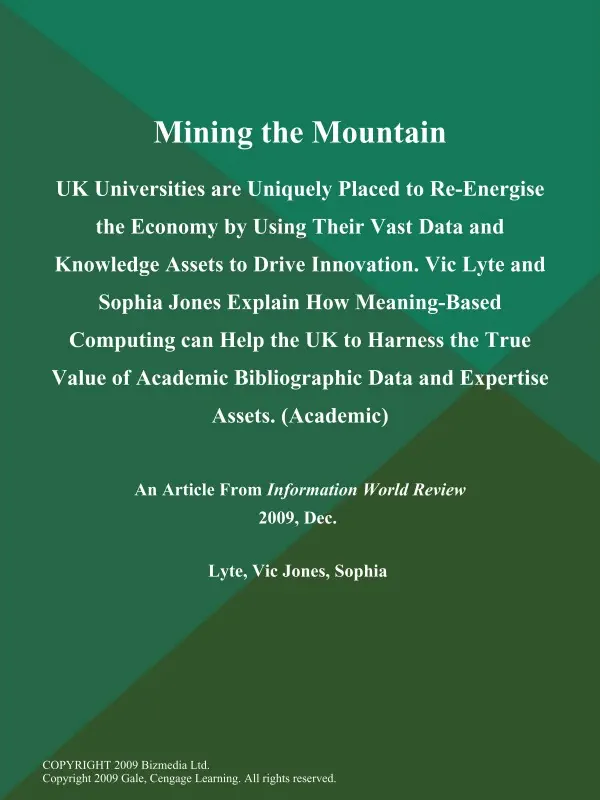
Mining the Mountain
Information World Review
Turn its ideas into short, game-like lessons you’ll actually finish.
About Mining the Mountain
Meet Susan. She's a researcher who submits a proposal to study an area relating to the use of spectroscopy to better understand stem cells. She is trying to isolate the key variables underlying such studies. So she goes to Google Scholar and focuses her preliminary search on the subject-specific terms "stem cells and spectroscopy". Google Scholar returns with a daunting list of 50,400 artefacts ranked according to the number of contextually unrelated hits rather than the focus of inquiry Susan is seeking. And that's just the stuff that Google knows about. Far more is hidden within the UK's 106 institutional university repositories, which hold over half a million artefacts. There is a vast quantity of information residing within UK universities and tapping it effectively is the toughest of nuts to crack. Susan's frustration in trying to find a needle in a haystack is shared by academics and researchers all over the country.
A smarter reading
and learning experience.
Hooked from page one.Every lesson opens on a question you want to answer, so your mind stays on it instead of drifting off.


Get it in seconds.Right after you answer, a few plain words show why. No dense chapters to push through.

Use it this week.Pick the moment you’ll use the idea in your own life, so it turns into a habit, not a highlight.

Questions about Mining the Mountain
What is Mining the Mountain about?
She's a researcher who submits a proposal to study an area relating to the use of spectroscopy to better understand stem cells. She is trying to isolate the key variables underlying such studies.
Who wrote Mining the Mountain?
Information World Review wrote Mining the Mountain.
Is there a summary of Mining the Mountain?
MEMRBL doesn’t summarize it. It turns its ideas into short lessons on your iPhone: you guess first, see why, and plan where you’ll use each idea this week.
How do I remember what I read in Mining the Mountain?
Answer questions about it instead of reading it again. Recalling an idea makes it stick better than rereading it (Pan and Sana, 2021). That is how every MEMRBL lesson works.
What books are like Mining the Mountain?
HBR's 10 Must Reads on AI, Bold and Data Scientists at Work. See all books like Mining the Mountain.
Books like Mining the Mountain
See all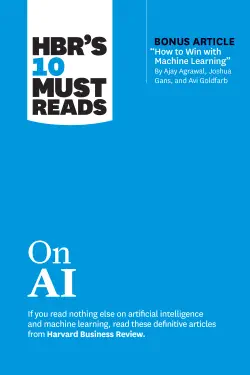





Explore more books
Put Mining the Mountain to work.
Short lessons on your iPhone. Free to download.