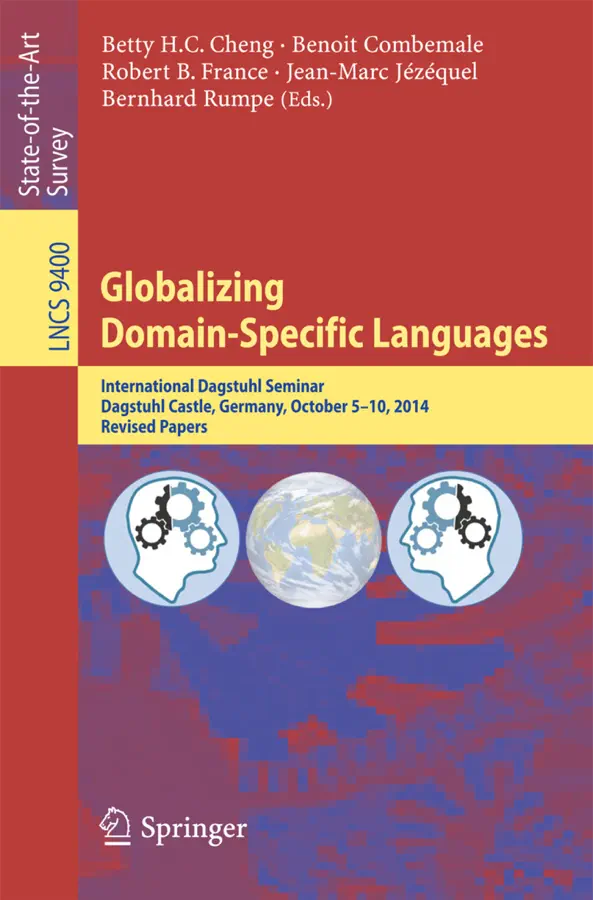
Globalizing Domain-Specific Languages
Benoit Combemale, Betty H.C. Cheng, Robert B. France, Jean-Marc Jézéquel & Bernhard Rumpe
Turn its ideas into short, game-like lessons you’ll actually finish.
About Globalizing Domain-Specific Languages
The development of modern complex software-intensive systems often involves the use of multiple DSMLs that capture different system aspects. Supporting coordinated use of DSMLs leads to what we call the globalization of modeling languages, that is, the use of multiple modeling languages to support coordinated development of diverse aspects of a system.
In this book, a number of articles describe the vision and the way globalized DSMLs currently assist integrated DSML support teams working on systems that span many domains and concerns to determine how their work on a particular aspect influences work on other aspects.
Globalized DSMLs offer support for communicating relevant information, and for coordinating development activities and associated technologies within and across teams, in addition to providing support for imposing control over development artifacts produced by multiple teams. DSMLs can be used to support socio-technical coordination by providing the means for stakeholders to bridge the gap between how they perceive a problem and its solution, and the programming technologies used to implement a solution. They also support coordination of work across multiple teams. DSMLs developed in an independent manner to meet the specific needs of domain experts have an associated framework that regulates interactions needed to support collaboration and work coordination across different system domains. The articles in the book describe how multiple heterogeneous modeling languages (or DSMLs) can be related to determine how different aspects of a system influence each other. The book includes a research roadmap that broadens the current DSML research focus beyond the development of independent DSMLs to one that provides support for globalized DSMLs.
A smarter reading
and learning experience.
Hooked from page one.Every lesson opens on a question you want to answer, so your mind stays on it instead of drifting off.

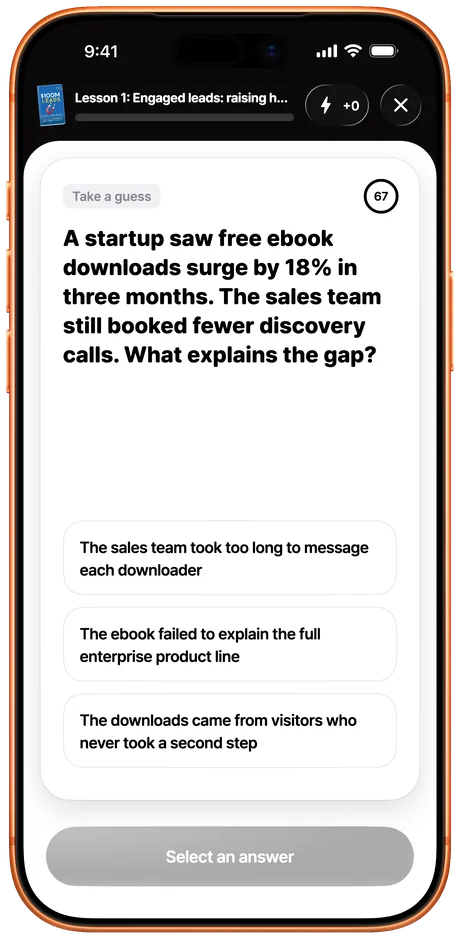
Get it in seconds.Right after you answer, a few plain words show why. No dense chapters to push through.

Use it this week.Pick the moment you’ll use the idea in your own life, so it turns into a habit, not a highlight.

Questions about Globalizing Domain-Specific Languages
What is Globalizing Domain-Specific Languages about?
The development of modern complex software-intensive systems often involves the use of multiple DSMLs that capture different system aspects.
Who wrote Globalizing Domain-Specific Languages?
Benoit Combemale, Betty H.C. Cheng, Robert B. France, Jean-Marc Jézéquel & Bernhard Rumpe wrote Globalizing Domain-Specific Languages.
Is there a summary of Globalizing Domain-Specific Languages?
MEMRBL doesn’t summarize it. It turns its ideas into short lessons on your iPhone: you guess first, see why, and plan where you’ll use each idea this week.
How do I remember what I read in Globalizing Domain-Specific Languages?
Answer questions about it instead of reading it again. Recalling an idea makes it stick better than rereading it (Pan and Sana, 2021). That is how every MEMRBL lesson works.
What books are like Globalizing Domain-Specific Languages?
REST in Practice, Computer Networking and iPhone User Guide for iOS 8.4. See all books like Globalizing Domain-Specific Languages.
Books like Globalizing Domain-Specific Languages
See all


Explore more books
Put Globalizing Domain-Specific Languages to work.
Short lessons on your iPhone. Free to download.