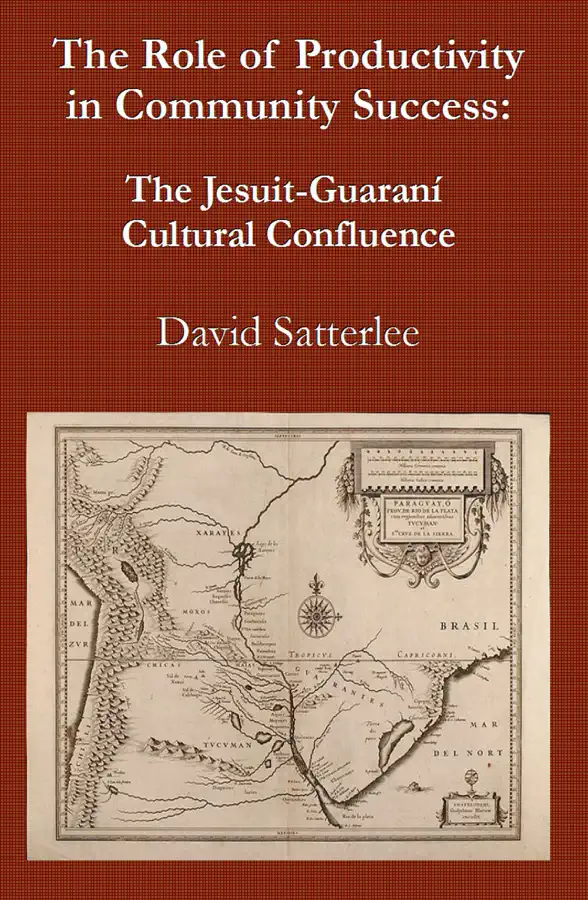
The Role of Productivity in Community Success
David Satterlee
Turn its ideas into short, game-like lessons you’ll actually finish.
About The Role of Productivity in Community Success
(Note: This material appeared previously in "Chum For Thought: Throwing Ideas into Dangerous Waters" by the same author.) This historical essay, drawn from the deepest jungles of Uruguay in South America, examines the creation of a flourishing culture and economy that lasted for almost two centuries. It explores the guided development of a virtuous web of social and economic controls that mixed the philosophy of Catholic Jesuit missionaries with the traditions of the native Guaraní peoples.
An unprecedented experiment in progressive community-building may have once created that rarest of cultural treasures – a functional and stable utopia... ended only by outside pressures of conquest and exploitation.
This is a living parable for our changing world, now suffering from seemingly-intractable political, cultural and economic turmoil… and struggling to be born into a tenuous future on uncertain threads of hope and despair. Rapid introduction of technology, educational systems, health care systems and social order have succeeded before – balancing competition and consumption in a new kind of community – and might be made to work again as we seek to create our own "new economy."
In this startling synthesis, Mr. Satterlee brings together and introduces: • historical records, • the social theories of the Catholic Church, • the management theories of Peter Drucker, • the psycho-social theories of Don Beck’s Spiral Dynamics Integral, and • the economics ideas of William Lewis and the McKinsey Global Institute on “the power of productivity.”
A smarter reading
and learning experience.
Hooked from page one.Every lesson opens on a question you want to answer, so your mind stays on it instead of drifting off.



Get it in seconds.Right after you answer, a few plain words show why. No dense chapters to push through.

Use it this week.Pick the moment you’ll use the idea in your own life, so it turns into a habit, not a highlight.

Questions about The Role of Productivity in Community Success
What is The Role of Productivity in Community Success about?
(Note: This material appeared previously in "Chum For Thought: Throwing Ideas into Dangerous Waters" by the same author.) This historical essay, drawn from the deepest jungles of Uruguay in South America, examines the creation of a flourishing culture and economy that lasted for almost two centuries.
Who wrote The Role of Productivity in Community Success?
David Satterlee wrote The Role of Productivity in Community Success.
Is there a summary of The Role of Productivity in Community Success?
MEMRBL doesn’t summarize it. It turns its ideas into short lessons on your iPhone: you guess first, see why, and plan where you’ll use each idea this week.
How do I remember what I read in The Role of Productivity in Community Success?
Answer questions about it instead of reading it again. Recalling an idea makes it stick better than rereading it (Pan and Sana, 2021). That is how every MEMRBL lesson works.
What books are like The Role of Productivity in Community Success?
The Protestant Ethic and the Spirit of Capitalism, The Rational Optimist and When Helping Hurts. See all books like The Role of Productivity in Community Success.
Books like The Role of Productivity in Community Success
See all


Explore more books
Put The Role of Productivity in Community Success to work.
Short lessons on your iPhone. Free to download.