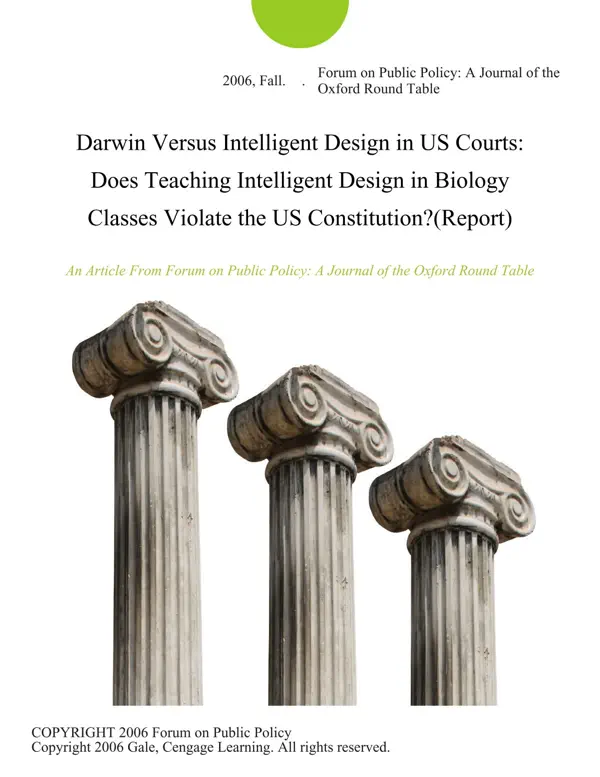
Darwin Versus Intelligent Design in US Courts
Forum on Public Policy: A Journal of the Oxford Round Table
Turn its ideas into short, game-like lessons you’ll actually finish.
About Darwin Versus Intelligent Design in US Courts
Abstract Darwinian evolution is accepted by the great majority of scientists as the method by which the diversity of earth's organisms, including humans, evolved. Current research continues to expand our knowledge of evolutionary mechanisms. However, certain religious groups, supporting teaching the creation of earth's species as outlined in Genesis ("Creationism"), challenge in US courts teaching only Darwinian evolution in biology classes. The Courts must decide whether teaching creationism violates the Constitution's First Amendment prohibiting government "establishment of religion". In a 2005 challenge (US District Court, Pennsylvania), a local school board mandated a disclaimer be read to biology classes stating there were gaps in Darwin's theory and that "Intelligent Design" (ID), propounded as science, provided a different explanation of life's origins. ID proposes that many living structures exhibit "irreducible complexity", could not have evolved via natural selection and, therefore, exhibit evidence of an intelligent designer. After expert testimony, the judge ruled (12/05) that ID was a form of religion, a modernized concept of creationism, and should not be taught in biology classes because it violated US and Pennsylvania Constitutions. Similar challenges to teaching Darwinian evolution are occurring in at least nine other US states.
A smarter reading
and learning experience.
Hooked from page one.Every lesson opens on a question you want to answer, so your mind stays on it instead of drifting off.



Get it in seconds.Right after you answer, a few plain words show why. No dense chapters to push through.

Use it this week.Pick the moment you’ll use the idea in your own life, so it turns into a habit, not a highlight.

Questions about Darwin Versus Intelligent Design in US Courts
What is Darwin Versus Intelligent Design in US Courts about?
Abstract Darwinian evolution is accepted by the great majority of scientists as the method by which the diversity of earth's organisms, including humans, evolved.
Who wrote Darwin Versus Intelligent Design in US Courts?
Forum on Public Policy: A Journal of the Oxford Round Table wrote Darwin Versus Intelligent Design in US Courts.
Is there a summary of Darwin Versus Intelligent Design in US Courts?
MEMRBL doesn’t summarize it. It turns its ideas into short lessons on your iPhone: you guess first, see why, and plan where you’ll use each idea this week.
How do I remember what I read in Darwin Versus Intelligent Design in US Courts?
Answer questions about it instead of reading it again. Recalling an idea makes it stick better than rereading it (Pan and Sana, 2021). That is how every MEMRBL lesson works.
What books are like Darwin Versus Intelligent Design in US Courts?
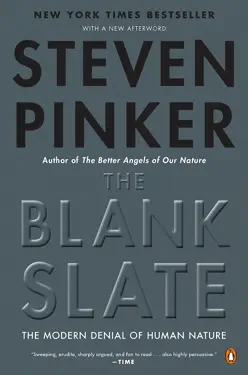
Merchants of Doubt, The God Delusion and The Blank Slate. See all books like Darwin Versus Intelligent Design in US Courts.
Books like Darwin Versus Intelligent Design in US Courts
See all


Explore more books
Put Darwin Versus Intelligent Design in US Courts to work.
Short lessons on your iPhone. Free to download.