Computational Genome Analysis
Richard C. Deonier, Simon Tavaré & Michael S. Waterman
Turn its ideas into short, game-like lessons you’ll actually finish.
About Computational Genome Analysis
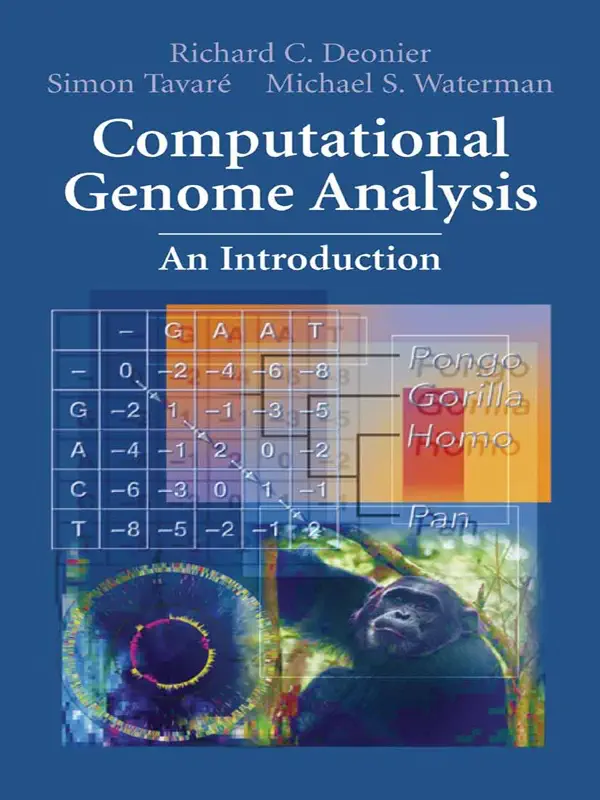
Computational Genome Analysis: An Introduction presents the foundations of key problems in computational molecular biology and bioinformatics. It focuses on computational and statistical principles applied to genomes, and introduces the mathematics and statistics that are crucial for understanding these applications. The book is appropriate for a one-semester course for advanced undergraduate or beginning graduate students, and it can also introduce computational biology to computer scientists, mathematicians, or biologists who are extending their interests into this exciting field.
This book features:Topics organized around biological problems, such as sequence alignment and assembly, DNA signals, analysis of gene expression, and human genetic variation.
Presentation of fundamentals of probability, statistics, and algorithms.
Implementation of computational methods with numerous examples based upon the R statistics package.
Extensive descriptions and explanations to complement the analytical development.
More than 100 illustrations and diagrams (some in color) to reinforce concepts and present key results from the primary literature.
Exercises at the end of chapters.
Richard C. Deonier is Professor Emeritus in the Molecular and Computational Biology Section of the Department of Biological Sciences at the University of Southern California. Originally trained as a physical biochemist, His major research has been in areas of molecular genetics, with particular interests in physical methods for gene mapping, bacterial transposable elements, and conjugative plasmids. During 30 years of active teaching, he has taught chemistry, biology, and computational biology at both the undergraduate and graduate levels.
Simon Tavaré holds the George and Louise Kawamoto Chair in Biological Sciences and is a Professor of Biological Sciences, Mathematics, and Preventive Medicine at the University of Southern California. Professor Tavaré's research lies at the interface between statistics and biology, specifically focusing on problems arising in molecular biology, human genetics, population genetics, molecular evolution, and bioinformatics. His statistical interests focus on stochastic computation. Among the applications are linkage disequilibrium mapping, stem cell evolution, and inference in the fossil record. Dr. Tavaré is also a professor in the Department of Oncology at the University of Cambridge, England, where his group concentrates on cancer genomics.
Michael S. Waterman is a University Professor, a USC Associates Chair in Natural Sciences, and Professor of Biological Sciences, Computer Science, and Mathematics at the University of Southern California. A member of the National Academy of Sciences and the American Academy of Arts and Sciences, Professor Waterman is Founding Editor and Co-Editor in Chief of the Journal of Computational Biology. His research has focused on computational analysis of molecular sequence data. His best-known work is the co-development of the local alignment Smith-Waterman algorithm, which has become the foundational tool for database search methods. His interests have also encompassed physical mapping, as exemplified by the Lander-Waterman formulas, and genome sequence assembly using an Eulerian path method.
A smarter reading
and learning experience.
Hooked from page one.Every lesson opens on a question you want to answer, so your mind stays on it instead of drifting off.

Get it in seconds.Right after you answer, a few plain words show why. No dense chapters to push through.

Use it this week.Pick the moment you’ll use the idea in your own life, so it turns into a habit, not a highlight.

Questions about Computational Genome Analysis
What is Computational Genome Analysis about?
Computational Genome Analysis: An Introduction presents the foundations of key problems in computational molecular biology and bioinformatics.
Who wrote Computational Genome Analysis?
Richard C. Deonier, Simon Tavaré & Michael S. Waterman wrote Computational Genome Analysis.
Is there a summary of Computational Genome Analysis?
MEMRBL doesn’t summarize it. It turns its ideas into short lessons on your iPhone: you guess first, see why, and plan where you’ll use each idea this week.
How do I remember what I read in Computational Genome Analysis?
Answer questions about it instead of reading it again. Recalling an idea makes it stick better than rereading it (Pan and Sana, 2021). That is how every MEMRBL lesson works.
What books are like Computational Genome Analysis?
The Vital Question, Your Inner Fish and Naked Statistics. See all books like Computational Genome Analysis.
Books like Computational Genome Analysis
See all



Explore more books
Put Computational Genome Analysis to work.
Short lessons on your iPhone. Free to download.