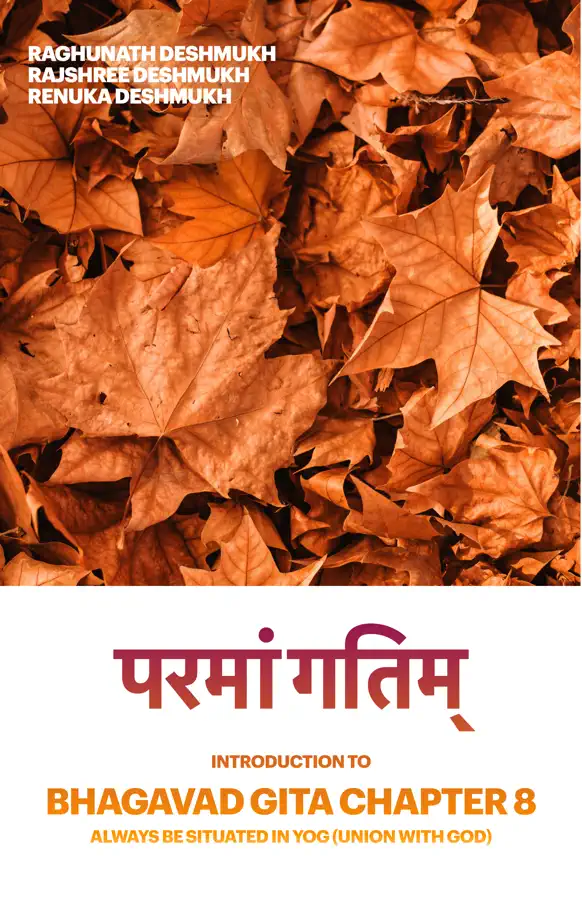
परमां गतिम्
Raghunath Deshmukh
Turn its ideas into short, game-like lessons you’ll actually finish.
About परमां गतिम्
The eighth chapter of the Bhagavad Gita is the second chapter in the section of the Bhagavad Gita that describes Sagun Brahman or God. The seventh chapter was the first one, where Shri Krishna spent a great deal of time explaining the attributes, characteristics, and capabilities of the Sagun Brahman.
If we remember, Shri Krishna ended the seventh chapter by introducing a few new terms unused earlier, and also, in the same Shloka, Shri Krishna mentioned that those who know him at the time of death will attain him.
The eighth chapter of the Bhagavad Gita starts with Arjun asking seven questions in the first two Shlokas of this chapter. He asks for the meanings of अधिभूत (Adhibhuta), अधिदैव (Adhidaiva), अधियज्ञ (Adhiyajna), ब्रह्म (Brahman), कर्म (Karma), and अध्यात्म (Adahyatma), which Shri Krishna answeres in the beginning of this chapter itself.
The seventh question, how is Brahman known at the time of death, becomes the central theme of the chapter, with Shri Krishna spending a great deal of time explaining it.
While some of us might achieve self-realization during this life, for others, there is another opportunity, whereby, at the time of death of the physical body, when we are transferring our identity from the physical body to the Karmic causal body if we focus on the God, we have an opportunity to achieve self-realization.
Shri Krishna explains several ways to achieve that, including the importance of devotion or Bhakti and the yogic way of leaving the body through Brahmarandhra. This chapter also touches upon the concepts of Yuga, Mahayuga, Kalpa, and the life of Brahmaji and how we could transcend them.
The chapter ends with Shri Krishna explaining the two paths for leaving this body, i.e., the path of Darkness that leads to rebirth and the path of Brightness that leads to liberation, along with the secret of success on the path of Brightness, so we all can pursue that reach the highest state of self-realization or liberation.
A smarter reading
and learning experience.
Hooked from page one.Every lesson opens on a question you want to answer, so your mind stays on it instead of drifting off.


Get it in seconds.Right after you answer, a few plain words show why. No dense chapters to push through.

Use it this week.Pick the moment you’ll use the idea in your own life, so it turns into a habit, not a highlight.

Questions about परमां गतिम्
What is परमां गतिम् about?
The eighth chapter of the Bhagavad Gita is the second chapter in the section of the Bhagavad Gita that describes Sagun Brahman or God. The seventh chapter was the first one, where Shri Krishna spent a great deal of time explaining the attributes, characteristics, and capabilities of the Sagun Brahman.
Who wrote परमां गतिम्?
Raghunath Deshmukh wrote परमां गतिम्.
Is there a summary of परमां गतिम्?
MEMRBL doesn’t summarize it. It turns its ideas into short lessons on your iPhone: you guess first, see why, and plan where you’ll use each idea this week.
How do I remember what I read in परमां गतिम्?
Answer questions about it instead of reading it again. Recalling an idea makes it stick better than rereading it (Pan and Sana, 2021). That is how every MEMRBL lesson works.
What books are like परमां गतिम्?
God Is One, Death; An Inside Story and The Magical Jewel of Devotion in Kashmir Shaivism. See all books like परमां गतिम्.
Books like परमां गतिम्
See all


Explore more books
Put परमां गतिम् to work.
Short lessons on your iPhone. Free to download.