Oracle Database 11g R2 Architecture & Internals
Sideris Courseware Corporation
Turn its ideas into short, game-like lessons you’ll actually finish.
About Oracle Database 11g R2 Architecture & Internals
Success in database administration and tuning, or in the development of database applications, depends upon having a sufficient understanding of the architecture and internal mechanisms which operate within the database. Without such an understanding, one could implement such things as structural changes, performance tuning adjustments and other modifications to the environment which could actually be counterproductive. The purpose of this unique and popular Oracle 11g training course is to reveal the underlying architecture of the Oracle database environment. This course is also intended to be of help to information technology (IT) managers and executives who require an understanding of the technology upon which they and their staff rely.
This course is often used in combination with other advanced Oracle database administration or database developer courses to provide the prerequisite foundation in the architecture of the database. Major objectives covered within this training guide include: Understanding the broader Oracle enterprise architecture, including the client, middleware and database tiers found within a multi-tiered enterprise environment; Understand key computing concepts such as parallelization, grid-based resource acquisition and clusters; Understanding the role of database machines, such as the Exadata database computing machines and storage machines; An in-depth exploration of the database architecture, including memory, process and data structures, and the composition of an Oracle database instance; Alternative modes of database operation, including dedicated server mode, shared servers mode, parallel execution and how one selects the appropriate mode for each environment; Consider the role of the Shared Global Area (SGA) and the various memory caches and subcaches which can be optionally configured within that space; Consider the complimentary role of the Program Global Area (PGA), also known as the Process Global Area; Discuss the role of the instance background processes, including those which are optional and those which can have additional instances optionally launched; Consider physical database storage structures such as tablespaces, data files, blocks and the internal format of rows; Consider the alternative row-level storage option of hybrid columnar compression; Compare and contrast internal storage of data segments, B-tree and bitmap index segments; Review all of the possible database object types which one may find within the logical application database; The schema and ownership context in which logical database objects reside; The editions context in which database objects can exist in different forms and how hot application upgrades are supported by database editions; This architectural discussion will be much more than just a presentation of theoretical concepts; After explaining in logical terms the architectural component under consideration, this course module will frequently show the component as it is actually rendered by the Enterprise Manager graphical interface for database administrators. At other times this course will use the SQL command-line interface to explain the characteristics of the architectural component being discussed; Furthermore, while other modules within this curriculum are focused on the actual administration of these database components, in some cases we will demonstrate within this course how one creates or configures some of these elements under discussion.
A smarter reading
and learning experience.
Hooked from page one.Every lesson opens on a question you want to answer, so your mind stays on it instead of drifting off.
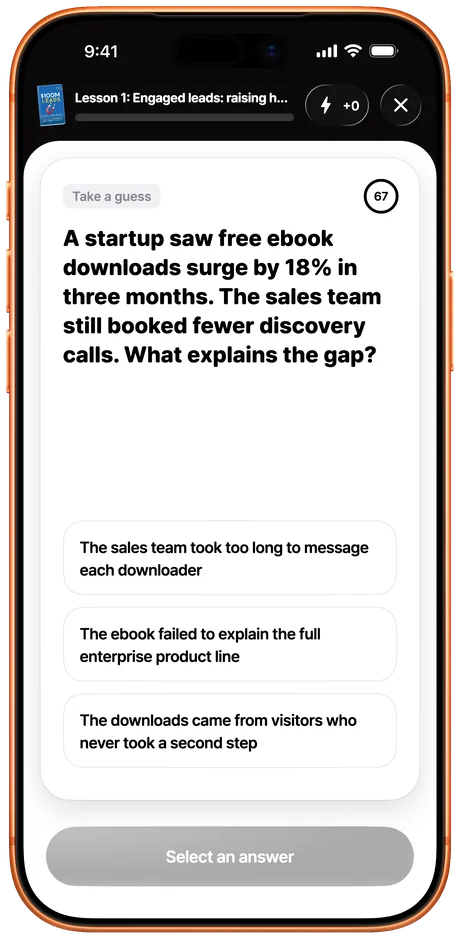
Get it in seconds.Right after you answer, a few plain words show why. No dense chapters to push through.

Use it this week.Pick the moment you’ll use the idea in your own life, so it turns into a habit, not a highlight.

Questions about Oracle Database 11g R2 Architecture & Internals
What is Oracle Database 11g R2 Architecture & Internals about?
Success in database administration and tuning, or in the development of database applications, depends upon having a sufficient understanding of the architecture and internal mechanisms which operate within the database.
Who wrote Oracle Database 11g R2 Architecture & Internals?
Sideris Courseware Corporation wrote Oracle Database 11g R2 Architecture & Internals.
Is there a summary of Oracle Database 11g R2 Architecture & Internals?
MEMRBL doesn’t summarize it. It turns its ideas into short lessons on your iPhone: you guess first, see why, and plan where you’ll use each idea this week.
How do I remember what I read in Oracle Database 11g R2 Architecture & Internals?
Answer questions about it instead of reading it again. Recalling an idea makes it stick better than rereading it (Pan and Sana, 2021). That is how every MEMRBL lesson works.
What books are like Oracle Database 11g R2 Architecture & Internals?
REST in Practice, Automated Data Collection with R and Statistics for Big Data For Dummies. See all books like Oracle Database 11g R2 Architecture & Internals.
Books like Oracle Database 11g R2 Architecture & Internals
See all


Explore more books
Put Oracle Database 11g R2 Architecture & Internals to work.
Short lessons on your iPhone. Free to download.