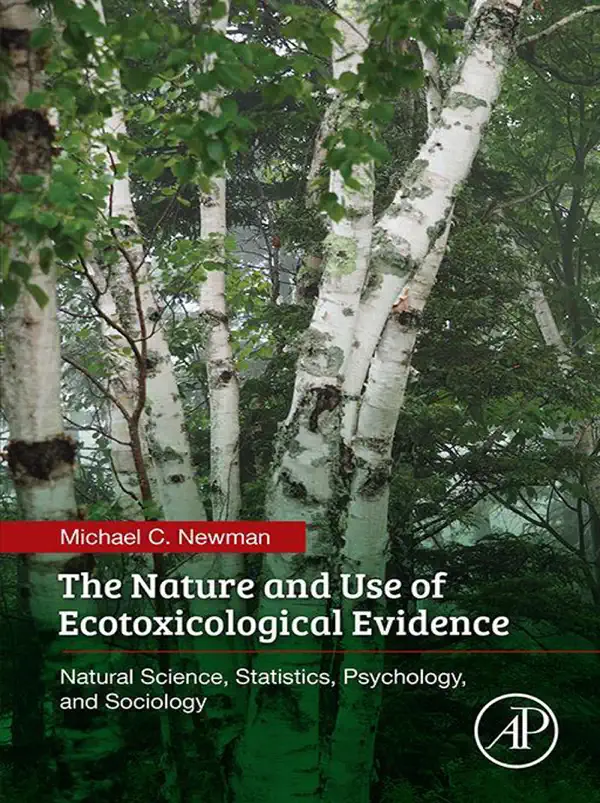
The Nature and Use of Ecotoxicological Evidence
Michael C. Newman
Turn its ideas into short, game-like lessons you’ll actually finish.
About The Nature and Use of Ecotoxicological Evidence
The Nature and Use of Ecotoxicological Evidence: Natural Science, Statistics, Psychology, and Sociology examines how toxicologists and environmental professionals come to understand and make decisions about possible harm from pollutants. Drawing on concepts and techniques from the natural, social and mathematical sciences, the book emphasizes how pollutant-related evidence is gathered, assessed, communicated and applied in decision-making. Each chapter begins with a real-world example before exploring fundamental cognitive, social, statistical or natural science concepts to explain the opening example. Methods from other disciplines for recognizing, reducing or removing the influence of impediments in wise decision-making are highlighted in each chapter.
Misreading evidence by the scientific community, and miscommunication to regulators and the public, remain major impediments to wise action in pollution issues. Which evidence comes to dominate the dialogue among scientists, regulators and decision makers depends on social and scientific dynamics. Yet psychological and sociological factors that influence the movement of evidence through scientific communities to regulators receive cursory discussion by professionals unfamiliar with the sociology literature. Toxicologists, environmental scientists, psychologists and professionals and students across the sciences will find the book useful for understanding how evidence is generated, assessed and communicated in their own fields.
- Includes groundbreaking research synthesizing information from across the sciences to understand the decision-making process
- Provides real life examples and uses theoretical concepts to analyze them in clear, direct language
- Encourages critical thinking about complex problems
A smarter reading
and learning experience.
Hooked from page one.Every lesson opens on a question you want to answer, so your mind stays on it instead of drifting off.

Get it in seconds.Right after you answer, a few plain words show why. No dense chapters to push through.

Use it this week.Pick the moment you’ll use the idea in your own life, so it turns into a habit, not a highlight.

Questions about The Nature and Use of Ecotoxicological Evidence
What is The Nature and Use of Ecotoxicological Evidence about?
The Nature and Use of Ecotoxicological Evidence: Natural Science, Statistics, Psychology, and Sociology examines how toxicologists and environmental professionals come to understand and make decisions about possible harm from pollutants.
Who wrote The Nature and Use of Ecotoxicological Evidence?
Michael C. Newman wrote The Nature and Use of Ecotoxicological Evidence.
Is there a summary of The Nature and Use of Ecotoxicological Evidence?
MEMRBL doesn’t summarize it. It turns its ideas into short lessons on your iPhone: you guess first, see why, and plan where you’ll use each idea this week.
How do I remember what I read in The Nature and Use of Ecotoxicological Evidence?
Answer questions about it instead of reading it again. Recalling an idea makes it stick better than rereading it (Pan and Sana, 2021). That is how every MEMRBL lesson works.
What books are like The Nature and Use of Ecotoxicological Evidence?
Thinking, Fast and Slow, A Field Guide to Lies and The Art of Uncertainty. See all books like The Nature and Use of Ecotoxicological Evidence.
Books like The Nature and Use of Ecotoxicological Evidence
See all


Explore more books
Put The Nature and Use of Ecotoxicological Evidence to work.
Short lessons on your iPhone. Free to download.