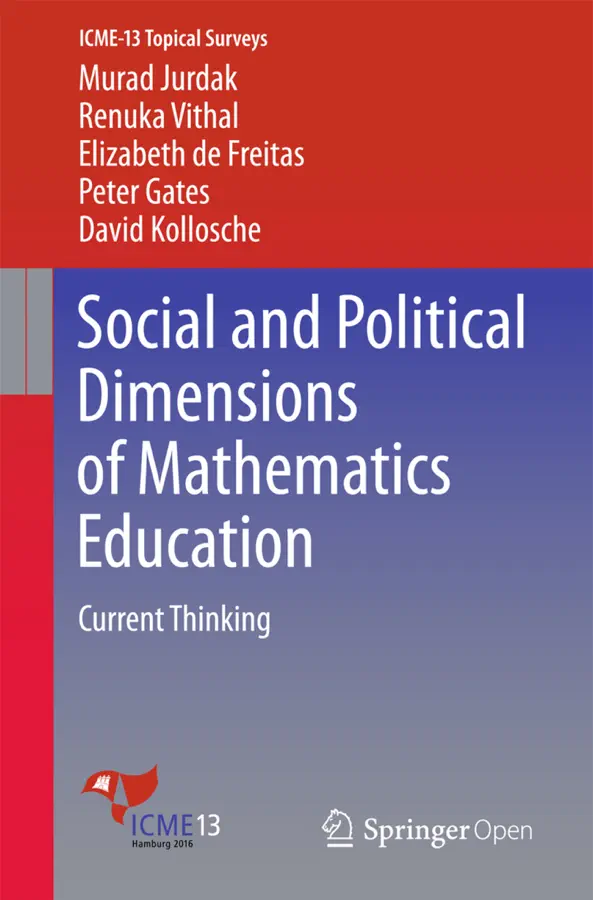
Social and Political Dimensions of Mathematics Education
Murad Jurdak, Renuka Vithal, Elizabeth de Freitas, Peter Gates & David Kollosche
Turn its ideas into short, game-like lessons you’ll actually finish.
About Social and Political Dimensions of Mathematics Education
This book examines the current thinking on five critical social and political areas in mathematics education. It focuses on material conditions in teaching and learning, and details features of social life and their influence on mathematics teaching, learning and achievement. Following an introduction, the first section addresses equitable access and participation in quality mathematics education. It explores this issue in different contexts and from different ideological perspectives. The second section traces the emergence and development of the notion of activism in mathematics education in theory, in the literature, in research and in practice. The third section then moves on to explore current research on the political forces at work in identity, subjectivity and (dis)ability within mathematics education, showing how emphasis on language and discourse provides information for this research, and how new directions are being pursued to address the diverse material conditions thatshape learning experiences in mathematics education. Economic factors behind mathematics achievement form the topic of section four, which examines the political dimensions of mathematics education through the influence of national and global economic structures. The final section addresses distribution of power and cultural regimes of truth, based on the premise that although often deemed apolitical, mathematics and mathematics education are highly political institutions in our society. The book concludes with a summary and recommendations for the future.
A smarter reading
and learning experience.
Hooked from page one.Every lesson opens on a question you want to answer, so your mind stays on it instead of drifting off.




Get it in seconds.Right after you answer, a few plain words show why. No dense chapters to push through.

Use it this week.Pick the moment you’ll use the idea in your own life, so it turns into a habit, not a highlight.

Questions about Social and Political Dimensions of Mathematics Education
What is Social and Political Dimensions of Mathematics Education about?
This book examines the current thinking on five critical social and political areas in mathematics education. It focuses on material conditions in teaching and learning, and details features of social life and their influence on mathematics teaching, learning and achievement.
Who wrote Social and Political Dimensions of Mathematics Education?
Murad Jurdak, Renuka Vithal, Elizabeth de Freitas, Peter Gates & David Kollosche wrote Social and Political Dimensions of Mathematics Education.
Is there a summary of Social and Political Dimensions of Mathematics Education?
MEMRBL doesn’t summarize it. It turns its ideas into short lessons on your iPhone: you guess first, see why, and plan where you’ll use each idea this week.
How do I remember what I read in Social and Political Dimensions of Mathematics Education?
Answer questions about it instead of reading it again. Recalling an idea makes it stick better than rereading it (Pan and Sana, 2021). That is how every MEMRBL lesson works.
What books are like Social and Political Dimensions of Mathematics Education?
The Sociological Imagination, The New Jim Crow and How to Be an Antiracist. See all books like Social and Political Dimensions of Mathematics Education.
Books like Social and Political Dimensions of Mathematics Education
See all


Explore more books
Put Social and Political Dimensions of Mathematics Education to work.
Short lessons on your iPhone. Free to download.