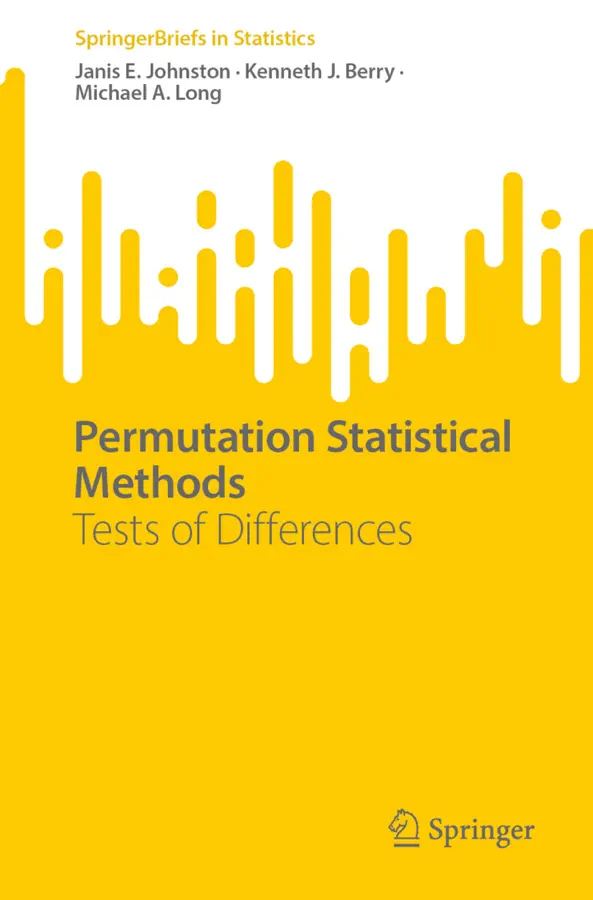
Permutation Statistical Methods
Janis E. Johnston, Kenneth J. Berry & Michael A Long
Turn its ideas into short, game-like lessons you’ll actually finish.
About Permutation Statistical Methods
The primary purpose of this book is to introduce the reader to elementary statistical methods as related to tests of differences, such as one-sample tests, tests of two independent samples, tests of two matched samples, and one-way analysis of variance. Throughout the book the emphasis is on permutation statistical methods, although the results of the permutation analyses are always compared and contrasted with the results of conventional statistical analyses. Unlike classical statistical methods, permutation statistical methods do not rely on theoretical distributions, avoid the usual assumptions of normality and homogeneity, depend only on the observed data, and do not require random sampling. The book is designed for an audience with limited statistical background and can easily serve as a supplementary textbook in an undergraduate or graduate course in departments such as statistics, psychology, economics, or biology. In particular, the audience for this book is quantitative undergraduate and graduate students in fields such as psychology, sociology, biology and political science. No statistical training beyond a first course in statistics is required.
A smarter reading
and learning experience.
Hooked from page one.Every lesson opens on a question you want to answer, so your mind stays on it instead of drifting off.


Get it in seconds.Right after you answer, a few plain words show why. No dense chapters to push through.

Use it this week.Pick the moment you’ll use the idea in your own life, so it turns into a habit, not a highlight.

Questions about Permutation Statistical Methods
What is Permutation Statistical Methods about?
The primary purpose of this book is to introduce the reader to elementary statistical methods as related to tests of differences, such as one-sample tests, tests of two independent samples, tests of two matched samples, and one-way analysis of variance.
Who wrote Permutation Statistical Methods?
Janis E. Johnston, Kenneth J. Berry & Michael A Long wrote Permutation Statistical Methods.
Is there a summary of Permutation Statistical Methods?
MEMRBL doesn’t summarize it. It turns its ideas into short lessons on your iPhone: you guess first, see why, and plan where you’ll use each idea this week.
How do I remember what I read in Permutation Statistical Methods?
Answer questions about it instead of reading it again. Recalling an idea makes it stick better than rereading it (Pan and Sana, 2021). That is how every MEMRBL lesson works.
What books are like Permutation Statistical Methods?
Naked Statistics, How the World Really Works and Scale. See all books like Permutation Statistical Methods.
Books like Permutation Statistical Methods
See all


Explore more books
Put Permutation Statistical Methods to work.
Short lessons on your iPhone. Free to download.