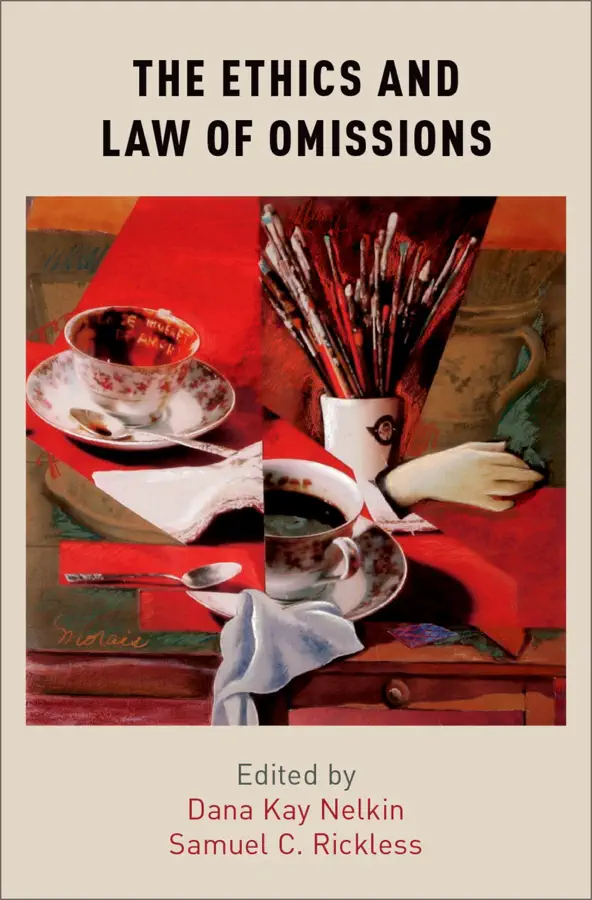
The Ethics and Law of Omissions
Dana Kay Nelkin & Samuel C. Rickless
Turn its ideas into short, game-like lessons you’ll actually finish.
About The Ethics and Law of Omissions
This edited volume of new essays explores the principles that govern moral responsibility and legal liability for omissive conduct—behavior that did not occur.
Many contributors here try to make sense of the possibility of moral responsibility for omissions, including those that occur unwittingly. The disagreements among them concern the grounds of moral responsibility in these cases: the constellation of states and traits that constitute the self, or the quality of one's will, or exercises of evaluative judgment, or the ability and opportunity to avoid the omission, or the tracing back to a time when one had the witting ability to take steps to avoid future omission. Some contributors consider whether omissions need to be under one's control if one is to be morally responsible for them, as well as which sense of "control" is relevant, if it is, to the question of moral responsibility. Yet others consider whether it is possible for an agent to be morally responsible for an omission that she could not have avoided. On the legal side, contributors also consider various issues concerning the status of omissions in the law: whether circumstances that are usually described as involving legal liability for omissions are better described as involving legal liability for entire courses of conduct; the conditions (such as creation of the peril) under which one can be legally liable for an omission to rescue; why a defendant's legal guilt for a crime can be predicated on an omission to act only if the defendant was under a legal duty to engage in the omitted act; and whether this "duty requirement" is grounded in the desirability of shielding from legal liability those who are not criminally culpable or in the constraint that one's body and property may not be appropriated for the general good.
Included with the essays is an introduction to the topic by the volume editors. The book will be of interest to moral philosophers, philosophers of law, and other legal scholars.
A smarter reading
and learning experience.
Hooked from page one.Every lesson opens on a question you want to answer, so your mind stays on it instead of drifting off.




Get it in seconds.Right after you answer, a few plain words show why. No dense chapters to push through.

Use it this week.Pick the moment you’ll use the idea in your own life, so it turns into a habit, not a highlight.

Questions about The Ethics and Law of Omissions
What is The Ethics and Law of Omissions about?
This edited volume of new essays explores the principles that govern moral responsibility and legal liability for omissive conduct—behavior that did not occur.
Who wrote The Ethics and Law of Omissions?
Dana Kay Nelkin & Samuel C. Rickless wrote The Ethics and Law of Omissions.
Is there a summary of The Ethics and Law of Omissions?
MEMRBL doesn’t summarize it. It turns its ideas into short lessons on your iPhone: you guess first, see why, and plan where you’ll use each idea this week.
How do I remember what I read in The Ethics and Law of Omissions?
Answer questions about it instead of reading it again. Recalling an idea makes it stick better than rereading it (Pan and Sana, 2021). That is how every MEMRBL lesson works.
What books are like The Ethics and Law of Omissions?
Free Will, Nicomachean Ethics and Apology. See all books like The Ethics and Law of Omissions.
Books like The Ethics and Law of Omissions
See all


Explore more books
Put The Ethics and Law of Omissions to work.
Short lessons on your iPhone. Free to download.